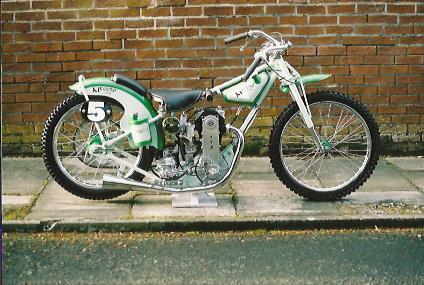
From my friend Benny Ludolphy in Holland... a very sad looking, but highly unusual Autorace machine with a BSA B31/33 engine. This must be from the pre-tarmac days, when our Japanese friends were still allowed to race on proper dirt tracks....
Showing posts with label Auto Race. Show all posts
I've been talking to my friend Ian Paterson this week. He has collected and restored what is probably the finest collection of dirt-track and speedway bikes in the country and as a treat for all the dirt track junkies out there, Ian is very kindly throwing open the doors of his magnificent collection for some open days this year. The collection is based just outside of Edinburgh. If you are interested in taking a look, give Ian a call on (+44)131 440 0864, leave your contact details and Ian will call you back. This is a once in a blue moon opportunity and I promise that you will not be disappointed.
Here's a few photos to give you a flavour of what's in store... (Photos are all copyright of Ian Paterson).
![]() |
| 1929 OEC - duplex steering, long wheel base and suicide shift - Now that would really be something to get sideways! |
![]() |
| 1930 James V-Twin - lovin' that fancy exhaust. |
![]() |
| 1930 Norton. This famous British Marque produced a dirt track bike based on their famous road racing machines. You can see more about the bike here. |
![]() |
| 1934 Crocker - painted in the colours of Manuel Trujillo. You can read more about the history of the Crocker in my previous post here |
![]() |
| 1934 Harley-Davidson CAC. The Harley-D Cinder Racer is a rare beast but there are more on my previous post here. |
![]() |
| The Vampire! 1947 Vincent with copper plated frame. |
![]() |
| 1957 Meguro - Japanese Autorace bike with asymetrical handlebars. |
Just picked up these beauty old Honda racers from the Japanese Auto Race blog.
HKS Hasegawa Autorace bike from the 1980s.
I really can't believe how many motorcycle and bicycle images I've collected over the years. I have just bought myself a diskette reader and transferred literally hundreds of old images to my laptop, most of which I had completely forgotten about. My previous posts about the Japanese auto race bikes prompted me to find these particular pictures again. I have no idea where most of them came from but they do prove that there's more to the Japanese motorcycle industry than just Honda, Kawasaki, Suzuki and Yamaha!
350cc Kyokuto KT
Meguro... Eventually became part of the Kawasaki empire. This engine bares a remarkable resemblence to the British J.A.P. unit
Another Meguro, this time with external cam-chain instead of the push rods in the previous picture.
TOYO - I really don't know much about this make at all, but they were succesful on the pre-1960 Japanese dirt tracks and continued to be so on the tarmac auto race tracks.
Another TOYO from the 1970s
We now know that this is not a Kyokuto, so what is the mystery twin cylinder engine in this Autoracer? It's a Toyo. Take a look at the image below and compare, this is a twin cylinder, DOHC Toyo with a 4-valve head... Thanks to Bennie Ludolphy in Hollland for his valuable information.
I've dug out my old silver halide images and scanned in a photograph of a genuine 1971 Kyokuto KT2 engine to compare and it is clearly very different.
This particular engine has been fitted into a 1970s Jawa speedway rolling chassis and is a replica of the bike that was tested at Canterbury speedway in 1972. A similar set-up was also tested in Australia in a Hagon Chassis. The engine has been modified to run on methanol with the addition of an amal carburettor. The engine and chassis were restored by ace speedway collector, sometime poet and ex-Berwick rider Ian Paterson and form part of his magnificent Cinder to Shale collection. Ian also has a genuine HKS Hasegawa Auto Race bike in his collection (see below). This bike dates from the early 1980s and is similar to the bike Barry Briggs had on display at the old Speedway collection at Donington Park.
Finally, I have to apologise for the poor quality of this image, but this is the only picture I have ever found of an EiCoH Auto Race bike....
EiCoH, or Engine Company Honda to give it its full name, was a side project of Kazuo Honda, one of the family members behind the Kyokuto. Kazuo was also developing the JRM (Japanese Race Motor) for road racing at the same time. The EiCoH was a 500cc single based on his families KT2 unit but with some modifications. This photo from a Dutch magazine shows the complete 1967 EiCoH speedway bike, basically an Auto Race machine without the asymetric bars!
Here is a cool Triumph powered Japanese Auto Race bike from the Dan Rouit Flat Track Museum:
This rare Triumph powered racer was found in the early 1990s under a wood pile, behind an antique store in Tokyo. Wayne Bialls, an American car collector from Phoenix, returned to the USA with his prize and proceeded with the restoration. When Bialls decided to sell the machine, he chose the VFT "For Sale" page and a quick call to Dan resulted in it being added to the growing museum collection. Dan’s good friend Aver Hensley, from Clovis, provided a proper set of handlebars, additional chroming and installation of the knee hook and number plates. The motorcycle was most likely raced until the early 1980s.
The picture above shows another Autoracer fitted with a twin cylinder Triumph 650cc engine, whilst the picture below is a Japanese Meguro engine, showing it's Triumph ancestry very clearly.
This Autoracer above looks like a Japanese Kyokuto KT2. * Thanks to Bennie Ludolphy we now know that this bike is not a Kyokuto but a twin cylinder, DOHC 4-valve Toyo; see this update *.
Kyokuto, (roughly translated as "sunrise" or "rising-sun"), were one of the oldest motorcycle engine firms in Japan. The Kyokuto Motor Industry Co Ltd produced its first engine in the mid 1930s, and ironically, the family name behind the company was Honda, in no way linked to the Honda Company of today. By the early 1960s, Kyokuto were producing around thirty 350cc and 500cc single cylinder engines every month
Todays Autoracers are powered by Suzuki SEAR (Suzuki Engine Auto Race) units, mostly AR600 twins but 500cc units are also produced for the novice riders. Kyokuto, (roughly translated as "sunrise" or "rising-sun"), were one of the oldest motorcycle engine firms in Japan. The Kyokuto Motor Industry Co Ltd produced its first engine in the mid 1930s, and ironically, the family name behind the company was Honda, in no way linked to the Honda Company of today. By the early 1960s, Kyokuto were producing around thirty 350cc and 500cc single cylinder engines every month
Many other engines have been used in Auto Race over the years including BSA, EiCoH and HKS Hasegawa. At least two Kyokuto engines have found their way to the UK and are in private collections. I also know of at least one complete HKS powered Auto Racer in a UK collection too.
I keep looking at the Japanese Auto Race web site and even with Google translate I can't make head nor tail of what is actually going on, but it looks like this guy, Takahashi Mitsugu is something of a legend having won ten consecutive races for the third time! A record ... I think!
Anyway, it's his new race suits that really caught my eye. Auto Racers resemble Power Rangers at the best of times, but Mitsugu san's new suits are even more lairy than a Wulfsport Jacket!
Now ... Which colour should I wear today?
Autorace in Japan is unique and it's a huge gambling sport. The riders are hidden from view and seperated from their bikes until the start of a race. They race in virtual silence while the spectators wait to see how much cash they've won or lost!!! Autorace can trace its origins back to speedway and dirt track racing, but racing on dirt was banned in the 60s when the authorities took control of Autorace. The bikes are 600cc Suzuki SEAR engines (Suzuki Engine Auto Race) and the riders resemble dayglo Samurai Warriors.
Subscribe to:
Posts (Atom)