I have a fascination with the pioneer dirt-track riders of the 1920s and 30s, some of whom have featured in previous blog posts, but there are three in particular who have really captured my imagination - Frank Charles, Clem Beckett and "Smoky" Stratton. They all led wildly different lives and were much more than just succesful speedway riders. My interest in Stratton was awakened when I discovered he was killed in a road accident just a few hundred yards from my first home in the Lake District. I then discovered that he was buried in a local cemetry and have continued to research his career and visit his grave ever since.
 |
| Spencer Charles Stratton, just after his arrival in the UK in April 1928. |
Spencer Charles Stratton was a true speedway pioneer and a real-life motorcycling free-spirit, always searching for a new and exciting challenge. He left his New Zealand homeland in 1923 aged just 19 to go racing in Australia. The following year he sailed half way around the World to the USA to try his luck on the American board tracks and eventually landed in Britain in 1928 to join the speedway revolution and quickly became one of the sports first international superstars. He risked his life racing motorcycles on every type of circuit, grass, board, cinders and even concrete, so how ironic that he was tragically killed in a road accident, driving home from a speedway meeting in rural Northern England.
Born in 1904, Stratton spent his early years on the family sheep farm at Colyton, just outside of Palmerston North, New Zealand. He was a bright kid, did well at school and was training to be a lawyer when the excitement of motorcycle racing lured him away from the bar and onto the grass tracks where he was an instant success. Notable victories included the North Island Grass Track Championships and the 1924 New Zealand Middleweight Championships. At the age of 19 he travelled to Australia to race and was soon bagging trophies, titles and records virtually everywhere he appeared. One Australian newspaper described him as "the most promising rider of the season" and predicted that Stratton "... will be the leading figure in motorcycling ... next season."
On 7th May 1924, he left Sydney aboard the SS Ventura arriving in San Francisco on May 26th. The challenge? To try his luck on the infamous board tracks of the USA. I have not discovered how he fared on his first visit to the USA, but he was back in Australia by August 1925, winning the 15mile Championship of Queensland and set 6 World Records over 1 mile, 3 miles and 5miles at Brisbane on August 24th using both his 350cc and 1000cc Indian motorcycles. Stratton was also quite an exponent riding his Indians on the fabulous 1 mile banked concrete Olympia Motor Speedway at Maroubra, in Australia.
 |
| The infamous Maroubra Speedway in New South Wales, known locally as the "Killer Track". |
Following this second succesful spell in Australia, Stratton returned to the USA in 1926 as a member of the Indian Works team and recorded some notable performances on the Altoona, Rockingham, and Fresno Board Tracks. He returned down under before the year was out and it was reported in the Canberra Times dated 2nd December 1926 that
"... Speeding Stratton registered 95mph on his Indian across the Bredabane Plains". Always pushing himself and his bikes to the limit, Stratton survived an horrific crash at the Hamilton Speedway in Newcastle, NSW, promoted incidentally by another New Zealander, the legendary Johnnie Hoskins. He remained unconcious for 23 days but eventually recovered, got right back on his bike and continued to set records and win titles at tracks in both Australia and on the 1 mile grass tracks in his homeland.
Dirt-track racing (soon to be re-christened Speedway) had arrived in the UK amid a blaze of publicity in 1928 and a flood of Aussie riders made their way to Britain to try and earn their fame and fortune. Smoky was amongst the first to join the exodus, joining promoter Johnnie Hoskins aboard the SS Oronsay as it set sail from Sydney bound for Southampton, arriving here in April 1928.
 |
| 350cc Indian single, similar to the one used by Smoky Stratton |
 |
| Smoky loved his 1000cc V-Twin Indian Daytona |
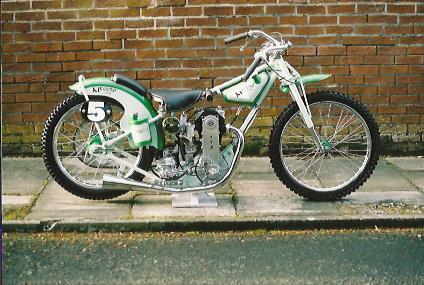
At this stage of his career Stratton had been exclusively racing two Indian motorcycles, a 350cc single and a 990cc Daytona Indian Chief, but he switched to riding the famous dirt-track Douglas bikes when he rode in the UK. He was one of the first real "Broadsliders" to appear on the British tracks and his name adorned the billboards all over the country - from Stamford Bridge in London to Marine Gardens in Scotland - "Smoky" Stratton as he was now known, really was thrilling the millions. Like many of the Aussie stars though, Stratton never really got to grips with the tighter tracks in the UK and he soon spread his wings onto the continent where he also ran his own track in Cologne in front of crowds in excess of 75.000!
 |
| Smoky aboard his Douglas in 1929 |
Motorcycle historian Cyril May described the spectacular German venue in an article in the Speedway Star and News dated 17/12/1967.
"Stratton's track gave a lap of 400 yards and was built immediately inside a concrete cycle racing track. The cycle track was banked almost vertically on the bends and on top of this banking, the front rows of spectators stood and looked down. ... Quite a lot of trouble was experienced in the matter of obtaining a permit from the police, who then controlled everything in Germany. Two weeks elapsed before they would give permission for a private demonstration and when some of the boys were at last allowed to put it over, the police ran for cover! It was only when things had been going on smooothly for about ten minutes, free from any slaughter, that they could be induced to spectate. In the end they were all for it."
Stratton had also became a partner in Provincial Dirt Tracks Ltd, the company that built the Owlerton Speedway Stadium at Sheffield in the UK and the White City Speedway at Cardiff in Wales. His partners included fellow riders Clem Beckett and Jimmy Hindle and a businessman named Edgar Hart. Even though his weatlth and business portfolio were starting to grow, Smoky still had a thirst for speed and danger and continued to race all over the World, never settling in one place for too long and always looking for the next big challenge. As well as being part owner of Sheffield, he also rode for the Yorkshire team in the 1929 English Dirt Track League and competed in the beach races at New Brighton near Liverpool. At the end of the British season he returned to the USA where, reunited with his beloved Indians, he continued his excellent form racing on the board tracks.
 |
| Another portrait of Smoky on his Douglas. This looks like the pits area at Sheffield. |
Back in the UK in 1930 he joined the Nottingham speedway team and by December of that year he had returned to Australia where he set another World speed record at the Ashfield Autodrome, covering a quarter mile in 17.8 seconds. He returned to the UK again in March 1931 and signed for the Plymouth speedway team. I also know that he rode in Vienna, Austria on September 1st 1932 and in 1933 he made a brief visit to his home in New Zealand. Interestingly, despite the fact that he raced motorcycles all over the World, I have found no records of Smoky ever riding on a New Zealand Speedway track at any time in his career.
"Smoky" eventually found his way back to the UK and teamed up with his old pal Johnnie Hoskins once again. In 1938, Hoskins reopened the track at Brough Park, Newcastle Upon Tyne and appointed Stratton as his manager. The Newcastle squad included eight Canadian riders at the time and also featured Roland and Maurice Stobbart from Cumberland. Roland was also promoting speedway at the Lonsdale Park track in Workington and had invited some of the Canadian riders to participate in a challenge match at the non-league venue on June 4th 1938. "Smoky" came along as team manager for the night and also acted as driver for the three Canadians, but on the journey home, driving along the Workington to Cockermouth Road, their car was involved in a head on collision with another car near to the village of Brigham.
Stratton was killed instantly, he was only 33 years old. The three Canadian riders, Bruce Venier, Ellwood Stilwell and Robert Sparks all suffered head and facial injuries, as did the occupants of the other car, driver John Roan of Cockermouth and his passenger, George Smith of Whitehaven. Ironically, another Canadian rider was also injured in a car accident that very night. George Pepper, the Newcastle captain, had turned down the chance of riding at Workington as he was due to ride at Edinburgh on the same night. He was involved in a head on collision on his way to Edinburgh and suffered cuts to his leg. The meeting he was due to race in was subsequently cancelled.
Maurice Stobbart had the sad task of identifying Smoky's body at the inquest, which was led by Inspector Woolcock. As "Smoky" had no family living in the UK, it was decided to bury him locally at the cemetry in Cockermouth.
The Inspector and one of his officers escorted the funeral courtege out of town and along the Lorton Road to the cemetry. The whole population of Cockermouth lined the streets to pay their last respects to this great sporting legend. Riders, officials and supporters from the Newcastle and Workington speedway tracks attended the funeral, along with Mr Ivison, the secretary of the Speedway Control Board, Jimmy Fraser, director of the Edinburgh Speedway and his great friend Johnnie Hoskins was there too. Hoskins played a big part in Smoky's life and it was only fitting that he should be there at the end too. Hoskins also had a gravestone erected to commemorate his freind and colleague.
Whenever I visit Smoky's grave I am always pleased to see fresh flowers laid there, but my inquisitive mind wanted to know who put them there as he had no family in the UK to my knowledge. Questions in the newspapers, on the internet and through the speedway fraternity had led nowhere, but a chance remark by Johnnie Hoskins in a 1967 edition of the Speedway Star and News gave me a clue. Hoskins said...
"I still often think of Smoky when he was with me at my Newcastle track in Australia, riding the big Indians in the mid twenties and also of his exploits on the big concrete track of Marouba. Neither have I forgotten those two devoted speedway supporters that corresponded with me for quite a time after the Stratton tradgedy ... they were the ones who so kindly tended 'Smoky's' grave in the little town of Cockermouth"Then. out of the blue, I received a reply to a note I had left at Smoky's grave, which gave me all of the answers. Inspector Woodcock, the man who had led the inquest and escorted Smoky's coffin to the cemetry, was a speedway fan from the Workington track. His young daughter was also a big speedway fan and felt so sorry for Smoky being buried so far away from his family and homeland that she promised to care and tend to his grave. Both of them wrote to Johnnie Hoskins and thro him they traced his family in New Zealand and began to correspond with them too - This young lady kept her promise and laid flowers at the grave every weekend until she passed away herself a few years ago and now her daughter and grandaughter are carrying on the tradition.
 |
Johnnie Hoskins paid for a headtone to be erected on Smoky's grave. Fresh flowers are placed there every week.
The inscription reads...
TO THE MEMORY OF
SPENCER CHARLES STRATTON
SPEEDWAY RIDER
FROM NEW ZEALAND
WHO WAS KILLED AT BRIGHAM
4th JUNE 1938 AGED 33 YEARS |
So Spencer Charles Stratton is not alone and I too will continue my little pilgrmage to the quiet, lonely grave of "Smoky" Stratton and pay my respects to a true motorcycling Trailblazer.