Showing posts with label Scooter. Show all posts

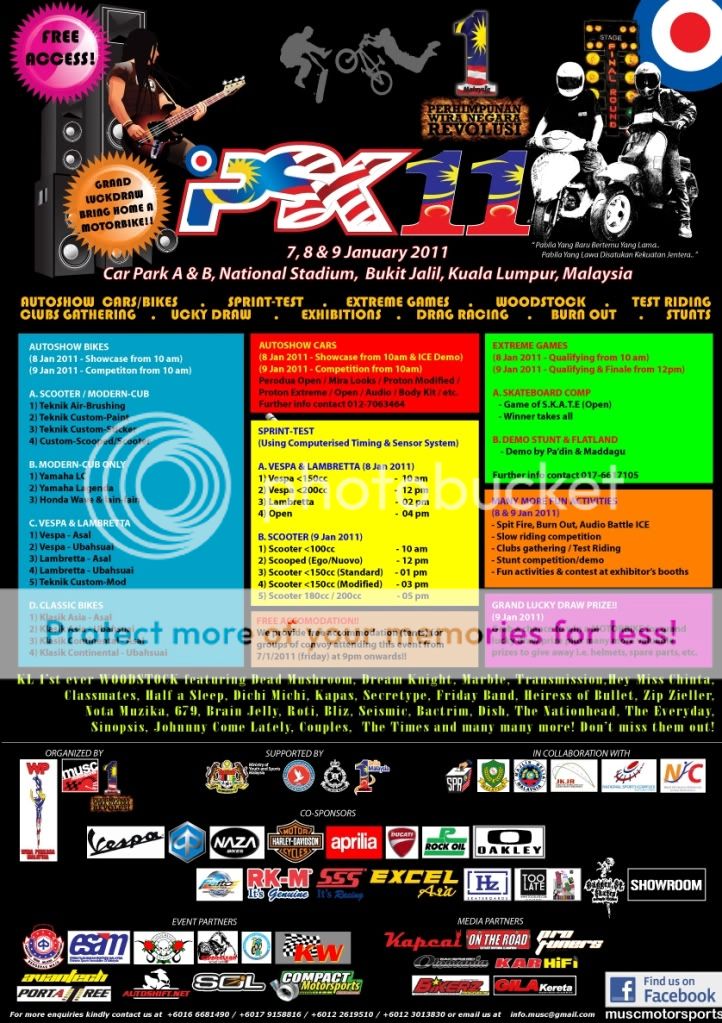
PSK 2011( Perhimpunan Skuter Kebangsaan Malaysia )


Festival which is certainly always welcomed by all the local motorsport fans, it seems the National Scooter Assembly (PSK) will be held again in 2011!

Festival featuring a motorsport category in which the majority of the scooter is not only involved a scooter, but there are also sport moped and vespa.

Apart from the events that took place that would surely drag racing motor sports (sprint test), also will run the Autoshow, Extreme Games, Woodstock, stunts, and others.


Prior to this, according to plans PSK 2010 will be held on 11 and 12 December 2010, held at Stadium Putra Bukit Jalil (Parking A & B), but it had to be delayed for some reason.

Although the date has changed many times, it seems this time it has been fixed for the final will be held from 7 to 9 January 2011, and is based in the same place the Putra Stadium in Bukit Jalil.

Moto PSK 2011 also draw attention to, "When you meet a new time, a vast flood of consolidated power machinery. " Wow!

KBS are pleased to inform the sponsor in collaboration with MUSC and the other two will provide the Association Scooters, Vespa, Lambretta & National Motor Classic in 2011 as the ad above. Therefore, all citizens vespa & lammy respected throughout the country are invited to join the giant program.

Among the activities will be held: -
1) Scooter Sprint Test (By CC & Model)
2) Vespa Sprint Test (150cc &> 200cc)
3) Lambretta Sprint Test (Open CC)
4) Autoshow Scooters / Vespa / Lambretta / Asia Motor Classic / Classic Motor Continental
5) Competition Extreme Sports (BMX Flatland / Street Skateboard / In-Line Skate Street)
6) Battle of Woodstock Indie Bands
7) Stunt Riding Competition (Scooter / Vespa)
8) Cool Competition Riding Slow (Scooter / Vespa)
9) Big Screen Cinema (Open Air)
10) Booths Promotion & Sales
11) Fun Joint Sponsor Activities
12) And Many More..

Whatever, do not miss the opportunity to go to the National Scooter Assembly 2011!

Brought to you by the MUSC Motorsports.

Vespa Motor Scooter Model Guides to Buy Used or New Vespa Scooters

When going to look at a scooter for sale, it is good to have a firm knowledge of what you are looking at. Often, the titles are incorrect as to the year of the scooter, or the owner may not even know for sure what the scooter is. With the following guides, you can be better informed regarding the year and model of your scooter.


VESPA 50 SPECIAL 1978 - 1983 
EXTERNAL FEATURES
- Rectangular Headlamp and Speedo
- Detachable Horn Cover
- Small Panel Door only on right side

- 300 x 10 Wheels
INTERNAL FEATURES
- BORE 38.4mm, STROKE 43mm, Carb Size 16/16 
- Can be increased to 125/135cc by changing the Crankshaft, Cylinder / Piston / Head, Head Cowling, Cylinder Holding Studs, Primary Gearing and Exhaust
- 6v AC unregulated power. Points Ignition


VESPA 90 AND VESPA 100 1964 - 1978
EXTERNAL FEATURES
- Round 105mm Headlamp and Small Round Speedo
- The horn cover is a part of the frame
- Small Panel door only on the right side

- 300 x 10 Wheels

INTERNAL FEATURES
- The crankshaft on the early V90 had a small End Brass Bush instead of a small End Bearing, making the piston not interchangeable with the later type unless the crankshaft was also changed
- BORE - V90 47mm, V100 49mm, STROKE - both have a 51mm Stroke
- Carb Size: V90 16/16 - V100 19/19
- 6V AC unregulated power. Points Ignition


100 SPORT 1976 - 1982 
EXTERNAL FEATURES
- As Vespa 100 but Ignition Switch on the handlebars
- Directional Indicators, 115mm Round Headlamp
- Small panel door on both sides

- 300 x 10 Wheels 

INTERNAL FEATURES
- As Vespa 100 but a USA specification machine with a daytime headlamp that cannot be turned off
- 12v DC powering Side Lights, Indicators, Horn And Brake Light, 12v AC regulated power used for the headlamp only
- Points ignition


PRIMAVERA 1966 - 1978 

EXTERNAL FEATURES
- As above but with a round 115mm Headlamp and Eye Shaped Speedo
- 300 x 10 Wheels 

INTERNAL FEATURES
- BORE - 55mm - STROKE 51mm
- Carb Size: 19/19
- 6v AC Unregulated Power
- Points Ignition


PK50S, PK50ES, PK80, PK100, PK125S 1982 - 1987
 EXTERNAL FEATURES
- Two piece handlebars with Round H/Lamp and Speedo
- Steering + Ignition Lock in one on the steering column
- Inside Legshield Toolbox
- Directional Indicators (no indicators on the PK100)
- Small Panel Door on both sides secured by locks above each door
- PK frames have an indentation in the frame under body close to the stand for exhaust clearance.
- Spare Wheel carrying facility under L/H Panel

- 300 x 10 Wheels 

INTERNAL FEATURES  
- The PK engine is basically an electronic 12V version of the V50/V90/V100/PRIM Engine
- BORE - PK50S+ES 38.4mm, PK100 49mm, PK125S+ES 55mm
- STROKE - PK50 43mm, all other PK models 51mm
- Same Crankshaft Taper as the V50/PRIM
- The PK50S was restricted to 30 MPH by a 16/10 Carb
- If changing engine for older style V50/PRIM: The PK Carburetor Inlet Manifold has to be retained because it points approx 1" over to the left more than the V50/PRIM
- PK50S + PK125S use 12v AC regulated lighting
- PK100 use 6v AC unregulated power, and has no indicators
- PK50ES + PK125ES use 12v DC power for Electric Starter, Horn, Indicators and Brake Light and use 12v AC power for headlights
- Electronic Ignition


PK125 ETS 1985 - 1987
EXTERNAL FEATURES
- Same headlight as PK models but has slightly different shaped handlebar cover
- Has sporty look and unique Cigar Shaped Exhaust that fits on L/H/S which means you could not fit a spare wheel under the L/H side panel
- Also has small Horn Grille Cut into the Legshield to the right of the horn casting
- 300 x 10 Wheels


INTERNAL FEATURES
- Same as PK125S + ES, BORE 55mm, STROKE 51mm, Electronic Ignition 12V AC regulated power


PK50XL, PK100XL, PK125XL 1987 - 1993
EXTERNAL FEATURES
- As PK/S above but with a Fuel Gauge in the Speedo, Floor Mats and Plastic Colour matched seat base and rear lower bodywork protection
- Panel Doors released by cable operated panel locks under the seat
- 300 x 10 Wheels
INTERNAL FEATURES
- Carburetor Inlet Manifold is held onto the engine by 3 Studs where as all the other small frame VESPA's have two
- Uses PX flywheel side Needle Bearing and Oilseal
- Larger Taper on the Crankshaft
- As above using 12v AC regulated power, Electronic Ignition (PK50XL now superseded by PK50 - FL2)


P125X, PX125E, P150X, P200E, PX200E 1978 - 1984
EXTERNAL FEATURES
- Ignition Switch in top handlebars
- Large Fully Detachable side panels
- Directional Indicators
- Spare Wheel Carrier under L/H panel
- Some later PX-E models had Oil Injection and 20mm Front Wheel Axle (known as PRE EFL models)

- 350 x 10 Wheels.

INTERNAL FEATURES
- BORE - P125X 52.5mm, P150X 57.8mm, P200E 66.5mm
- STROKE - All models 57mm
- 12v AC regulated power is used on all PX/PE models
- P125X, P150X use Points Ignition
- PX125E, P200E and PX200E use Electronic Ignition


PX125E-EFL, PX200E-EFL 1984 - 1999
EXTERNAL FEATURES
- As above but with the Ignition Switch Moved and integrated with the steering lock in the steering column, fuel gauge in the Speedo
- All EFL models are Oil Injection Type

- 350 x 10 Wheels


INTERNAL FEATURES
- As above but all models Electronic Ignition
- Some machines may have Electric Start and COSA Clutch
- 1999 versions of the above two models now have front disc brake fitted
- 2001 summer versions have Halogen Headlamp, Chrome Fittings and Vintage Style Speedo


T5 1985 - 1992
EXTERNAL FEATURES
- The frame is basically the same as PX125EFL but the rear section of the frame was extended to fit a longer seat unit, this can be seen as a seam above each panel
- The PX style floor runner strips where replaced by floor mats held in place by a spoiler
- A new style rectangular headlamp was fitted and a very large d shaped Speedo with a REV counter and a fuel gauge
- A small screen blade was fitted onto the top of the headset

- 350 x 10 Wheels

INTERNAL FEATURES
- BORE - 55mm, STROKE - 52mm
- A 5 Port Aluminium Barrel with a 2 Stud Loose Flange type exhaust fitting
- 12v AC regulated lighting power, electronic ignition


T5 CLASSIC 1993 - 1999
EXTERNAL FEATURES
- Not as T5 above but as the PX/EFL this machine was made after the T5 named "CLASSIC" due to its older PX type styling
- Uses floor mats and a spoiler as per the T5 but that's all.
- Handlebars are normal PX-EFL round headlamp and Speedo with fuel gauge.

- 350 x 10 Wheels

INTERNAL FEATURES
- Same engine as the T5 engine above
- Although the T5 engine casings and most of the top end components are unique to the T5, the engine as a unit will slot straight into a PX with no alterations necessary

T5 MILLENNIUM 1999 - 2000 
EXTERNAL FEATURES
As the T5 Classic but featured a disc brake and had a COSA type clutch fitted.


COSA (1) 125/200 1988 - 1992
EXTERNAL FEATURES
- Flatter more flush fitting horn cover and toolbox than PX models
- Ignition-Toolbox-Steering Lock, all one lock seat lock on side of the seat, with met-in facility under the seat.
- Round headlamp and an arch shaped Speedo with a rev counter and a fuel gauge, colour matched mirrors
- Hydraulic linked brakes - via the rear brake pedal
- 100 / 90 x 10 Wheels

INTERNAL FEATURES
- Engine mostly as PX125 or PX200 but with different casings, all models are Oil Injection, Electric Start was optional on both the 125cc and 200cc.
- Exhausts look like PX type but use a longer
- 3 inch bolt the Carb uses an air filter on the Carb and a secondary air filter in the air box accessed
- In the met-in compartment under the seat


COSA (2) 125/200 1992 - 1997/8
EXTERNAL FEATURES
- As above but the trim colour was now more of a Brown/Grey
- The wheel discs on the old COSA were replaced by a thinner
- Type ring that just covered the wheel nuts, the front suspension unit had no cover but had a chrome spring
- The seat lock was moved back to the rear of the seat, which was a more aftermarket looking seat
- With a colour matched plastic seat rear section, the mirrors on this model were not painted.
- 100 / 90 X 10 Wheels


INTERNAL FEATURES
- As above but very late models may have aluminium cylinder
- Also gear selection is by one single PUSH/PULL thick gear cable


Engine Number
Most Vespa Engine Numbers Can Be Located Just Below The Kickstart Pedal
On The Main Section Of The Swinging Arm. 


Frame Number / Chasis Number
Most Frame/Chassis Numbers Are Under The Engine Side Panel At The
Bottom Next To The Locating Hole.
Some Early Models Will Be At TheBottom Of The Tool Box/Side Panel
Or In Side The Side Panel/Tool Box, A Torch May Be Required To View. 


Vespa Chassis Number and Type by model and year

Vespa 50 ccm
Name
Year
Type
Chassis Number
Vespa 50/N 1963 - 1971 V5A1T 1001 - 283299
Vespa 50/5 1963 - 1990 V5A1T 1101 - 144061
Vespa 50/L 1966 - 1967 V5A1T 500001 - 530932
Vespa 50/L 1967 - 1970 V5A1T 540001 - 637063
Vespa 50/R 1969 - 1983 V5A1T 700001 - 938761
Vespa 50 Special 1969 - 1972 V5A2T 1001 - 96013
Vespa 50 Elestart 1969 - 1972 V5A3T 1001 - 5708
Vespa 50 Special 1972 - 1975 V5B1T 1001 - 95671
Vespa 50 Elestart 1972 - 1975 V5B2T 1001 - 3667
Vespa 50 Special 1975 - 1983 V5B3T 1101 - 565056
Vespa 50 Elestart 1975 - 1976 V5B4T 1101 - 1533
Vespa 50/S 1963 - 1984 V5SA1T 1101 - 130121+
Vespa 50 super sprint 1965 - 1971 V5SS1T 1001 - 3525
Vespa 50 Sprinter 1971 - 1979 V5SS2T 4001 - 10579
Vespa PK50 1982 - 1988 V5X1T 1101 - 17512
Vespa PK50S 1982 - 1986 V5X2T 1101 - 221578
Vespa PK50S Elestart 1983 - 1986 V5X2T 3000001 - 3009325
Vespa PK50SS 1983 - 1987 V5S1T 1101 - 7172
Vespa PK50SS Elestart 1983 - 1986 V5S1T 3000001 - 3001208
Vespa Automatica PK50S 1984 VA51T 1101 - 1352
Vespa Automatica PK50S El 1984 - 1986 VA51T 3000001 - 3002122
Vespa PK50XL Plurimatic 1986 - 1989 VA52T 1101 - 4989
Vespa PK50XL 1985 - 1990 V5X5T 1101 - 193519
Vespa PK50XL Elestart 1985 - 1990 V5X3T 3000001 - 3010706
Vespa PK50XL Plurimatic El 1986 - 1990 V???T 3000001 - 3014507
Vespa PK50XLS 1986 - 1990 V5S2T 001101 - 016464
Vespa PK50XLS Plurimatic 1987 - 1987 VA51T 1101 - 1670
Vespa PK50XLS Plurimatic El 1987 - 1989 VA51T 3000001 - 3000999
Vespa PK50XL Rush 1988 - 1990 V5X4T 1101 - 62170
Vespa PK50XL Rush Elestart 1988 - 1988 V5X4T 3000001 - 3002036
Vespa 50N 1989 - 1990 V5X5T 1101 - 44579
Vespa 50N Plurimatic 1989 - 1990 V5P1T 1101 - 6025
Vespa Scatto 1990 - 1990 TVP1T 1101 - 7948
Vespa Sfera 1990 - ? NSL1T 1101 - 2318
Vespa 50 1990 - 1990 VSN1T 1101 - 57991
Vespa 50 Automatica 1990 - 1990 V5P2T 1101 - 9064

Vespa 80 ccm
Name
Year
Type
Chassis Number
Vespa P80 - P80E 1980 - 1983 V8A1T 1001 - 9923
Vespa P80X - P80XE 1981 - 1983 V8X1T 1101 - 45710
Vespa PX80E Arcobaleno 1983 - 1990 V8X1T 100001 - 112348
Vespa PK80S 1982 - 1986 V8X5T 1101 - 6214
Vespa PK80S Elestart 1983 - 1984 V8X5T 3000001-300XXXX
Vespa Automatica PK80S 1984 VA81T 1101 - 2331
Vespa Automatica PK80S El 1984 - 1986 VA81T 3000001 - 3000737
Vespa PK80E Arcobaleno El 1984 - 1990 V8X1T 3000001 - 300335

Vespa 90 ccm
Name
Year
Type
Chassis Number
Vespa 90 1963 - 1984 V9A1T 1001 - 300026
Vespa 90 Super Sprint 1965 - 1971 V9SS1T 1001 - 6309
Vespa 90 Racer 1971 - 1974 V9SS2T 7001 - 10516

Vespa 98-100 ccm
Name
Year
Type
Chassis number
Vespa V98 1946 - 1947 V98 01 - 18079
Vespa 100 1978 - 1983 V9B1T 1101 - 28904
Vespa 100 1983 - 1990 V9B1T 50001 - 107758
Vespa PK100S 1982 - 1990 V9X1T 1101 - 69175
Vespa PK100S Elestart 1983 - 1986 V9X1T 3000001 - 3000158
Vespa PX100E 1983 - 1985 V1X1T 1101 - 44104
Vespa PK100XL 1986 - 1990 V9X2T 1101 - 2197

Vespa 125 cmm
Name Year Type Chassis Number
Vespa 125 / 125 Super 1948 - 1950 V1-15T 0001 - 104096
Vespa 125 / 125 Super 1950 - 1952 V33T 104097 - 251820
Vespa 125 / 125 Super 1952 - 1953 VM1T 1001 - 85870
Vespa 125 / 125 Super 1953 - 1954 VM2T 85871 - 176014
Vespa 125 / 125 Super 1953 VU1T 1001 - 7001
Vespa 125 / 125 Super 1954 - 1955 VN1T 1001 - 50100
Vespa 125 / 125 Super 1956 - 1957 VN2T 50101 - 125600
Vespa 125 / 125 Super 1957 - 1958 VNA1T 1001 - 68031
Vespa 125 / 125 Super 1958 - 1959 VNA2T 68032 - 116431
Vespa 125 / 125 Super 1959 - 1961 VNB1T 1001 - 89850
Vespa 125 / 125 Super 1961 VNB2T 1001 - 38699
Vespa 125 / 125 Super 1961 - 1962 VNB3T 34700 - 90395
Vespa 125 / 125 Super 1962 - 1963 VNB4T 90396 - 136485
Vespa 125 / 125 Super 1963 - 1964 VNB5T 1001 - 43240
Vespa 125 / 125 Super 1964 - 1966 VNB6T 1001 - 37028
Vespa 125 Super 1965 - 1969 VNC1T 1001 - 25146
Vespa 125 Primavera 1965 - 1967 VMA1T 1001 - 18100
Vespa 125 Primavera 1967 - 1983 VMA2T 20001 - 240329
Vespa 125 GT/Sprint 1966 - 1973 VNL2T 30001 - 81582
Vespa 125 GTR 1968 - 1978 VNL2T 100001 - 151788
Vespa 125 TS 1975 - 1978 VNL3T 1101 - 29804
Vespa Primavera ET3 1976 - 1990 VMB1T 1101 - 148923
Vespa P125X 1977 - 1982 VNX1T 1101 - 198248
Vespa PX125E 1981 - 1984 VNX2T 1101 - 135966
Vespa PX125E Arcobaleno 1983 - 1993 VNX2T 135402 - 284846
Vespa PK125 1982 - 1985 VMX1T 1101 - 8378
Vespa PK125S 1982 - 1986 VMX5T 1101 - 62606
Vespa PK125S Elestart 1983 - 1986 VMX5T 3000001 - 3006295
Vespa Automatica PK125S 1983 - 1986 VAM1T 1101 - 3366
Vespa Automatica PK125S El 1983 - 1984 VAM1T 3000001 - 3007758
Vespa PK125ETS 1984 - 1985 VMS1T 1101 - 12811
Vespa PX125E Arcobaleno El 1984 - 1990 VNX2T 3000001 - 3020135
Vespa PX125 T5 1985 - 1990 VNX5T 1101 - 37161
Vespa PX125 T5 Elestart 1985 - 1990 3000001 - 3005013
Vespa PK125XL 1986 - 1990 VMX6T 1001 - 54751
Vespa PK125XL Elestart 1986 - 1990 VMX6T 3000001 - 3006631
Vespa Cosa 125 1987 - 1990 VNR1T 1101 - 4844
Vespa Cosa 125 Elestart 1987 - 1990 VNR1T 3000001 - 3017315
Vespa PK125XL Plurimatic 1987 - 1990 VVM1T 1101 - 20103
Vespa PK125XL Plurimatic El 1987 - 1990 VVM1T 3000001 - 3001582
Vespa 125 Automatica 1990 - 1990 VVM2T 1101 - 1556
Vespa 125 1990 - 1990 VMX7T 1101 - 3046
Vespa 125 1990 - 1991 VMX7T 1000001 - 1002463

 Vespa 150-160-180
Name
Year
Type
Chassis Number
Vespa 150 / 150 Super 1954 - 1955 VL1T 1001 - 17000
Vespa 150 / 150 Super 1955 - 1956 VL2T 17001 - 93101
Vespa 150 / 150 Super 1956 - 1957 VL3T 93102 - 132737
Vespa 150 / 150 Super 1957 - 1958 VB1T 1001 - 99700
Vespa 150 / 150 Super 1958 - 1960 VBA1T 1001 - 125040
Vespa 150 / 150 Super 1960 - 1962 VBB1T 1001 - 146000
Vespa 150 / 150 Super 1962 - 1967 VBB2T 146001 - 280148
Vespa 150 / 150 Super 1965 - 1979 VBC1T 1001 - 554808
Vespa 150 GL 1957 - 1958 VGL1T 1001 - 16610
Vespa 150 GL 1959 - 1961 VGLA1T 1001 - 35267
Vespa 150 GL 1961 - 1962 VGLB1T 35268 - 48294
Vespa 150 GL 1962 - 1965 VLA1T 1001 - 80855
Vespa 150 Sprint 1965 - 1974 VLB1T 1001 - 1205477
Vespa 150 Sprint Veloce 1969 - 1979 VLB1T 150001 - 368119
Vespa 150 GS 1955 VS1T 1001 - 13300
Vespa 150 GS 1956 VS2T 13301 - 23310
Vespa 150 GS 1957 VS3T 23311 - 35310
Vespa 150 GS 1958 VS4T 35311 - 47350
Vespa 150 GS 1958 - 1961 VS5T 47351 - 127350
Vespa 160 GS 1962 - 1964 VSB1T 1001 - 61000
Vespa 180 Super Sport 1964 - 1968 VSC1T 1001 - 36700
Vespa 180 Rally 1968 - 1973 VSD1T 1001 - 27495
Vespa P150S 1978 - 1990 VBX1T 1101 - 299155
Vespa P150X 1978 - 1981 VLX1T 1101 - 346402
Vespa PX150E 1981 - 1985 VLX1T 346403 - 552410
Vespa PX150E Arcobaleno 1983 - 1990 VLX1T 600001 - 803233
Vespa PX150E Arcobaleno 1985 - 1990 VLX1T 2000001 - 2821048
Vespa PX150E Arcobaleno El 1984 - 1990 VLX1T 3000001 - 3010079
Vespa Cosa 150 1987 - 1990 VLR1T 1101 - 4308
Vespa Cosa 150 Elestart 1987 - 1990 VLR1T 3000001 - 3009413

Vespa 200
Name
Year
Type
Chassis Number
Vespa 200 Rally 1972 - 1979 VSE1T 1001 - 42275
Vespa P200X 1977 VSX1T 100 - 1700
Vespa P200E 1977 - 1982 VSX1T 1101 - 160000
Vespa PX200E 1982 - 1986 VSX1T 160001 - 195545
Vespa PX200E Arcobaleno 1983 - 1990 VSX1T 300001 - 424579
Vespa PX200E Arcobaleno El 1981 - 1990 VSX1T 3000001 - 3022538
Vespa Cosa 200 1988 - 1990 VSR1T 1101 - ???

Vespa Sprint Test Kuala Terengganu, Malaysia

Hello people!

Kuala Terengganu has celebrated their ceremony of being ‘4 Star rating’ state government last month. As people know, Terengganu is one of Malaysia's most-celebrated east coast states, well known for its exotic islands, pristine white beaches, crystal clear waters, quaint traditional villages and an unparalleled legacy of history and culture. A prestigious sailing competition, the Monsoon Cup Terengganu is dubbed as the "Formula One of Sailing.

On 9 January 2010, Persatuan Vespa Negeri Terengganu (PVNT) co-operate with the Kuala Terengganu City Council (MBKT) had organized  Vespa Sprint Test at Gong Badak near Stadium Sultan Mizan Zainal Abidin Kuala Terengganu. Almost 50 Vespa owners were registered their machines to take place in this event that are categorized by 2, Standard and Open Categories. Here we got some pictures at the day of event. The Open category was awesome!! Here we go!!


The competition gives a big money prizes and a medal to the participant. Besides that, participants also have chance to win a 29” TV and Sandwich Toaster on a Lucky Draw session. The prizes were given by Dato Razali Mat Kassim, Mayor of Kuala Terengganu.

Congratulations to Persatuan Vespa Negeri Terengganu (PVNT) and Kuala Terengganu City Council (MBKT) for their successfully organized the Vespa Sprint Test that first time organized at Terengganu. Hope will be more success at ASEAN Vespa Karnival this July. Thank You.

Original Post from - PVNT

Sprint Test Vespa

New Vespa S News

The appeal of the sporty ‘Vespino’ lives on in the shape of the all-new Vespa S, inspired by Vespa’s long traditions in young and dynamic scooter design. The minimalist styling of the Vespa S traces its origins back to legendary models like the 50 Special and the Vespa Primavera.

The 1970s began with man landing on the moon and went on to become a decade of extraordinary creativity, a period that revolutionised our way of life.
Fashion, design, cinema, and music, all played a part in transforming once rigid social conventions. Young people discovered a whole new awareness and became the driving force behind social change. The student protest movements that began in the late 1960s went on to shake Europe to the core.
In the cinema, films like Taxi Driver, the Godfather cycle, and the Deer Hunter set new standards. Rock music conquered the world, and grew into a host of genres. Led Zeppelin, Pink Floyd, CSN&Y, and Genesis pioneered new sounds and laid down the sound track to a decade that began with the break-up of the Beatles.

As always, rather than merely following fashion, Vespa led the way in creating new tendencies, and explicitly appealed to the younger generation, the real protagonists of those turbulent yet fertile years.

The Vespa Special and Vespa Primavera became the icons of a generation whose aspirations and conquests were to shape the world for decades to come. Compact, nippy, dynamic, and designed for sports riding, these were the models that inspired so many young people as they burst on to an exciting social scene.

The new Vespa S reflects the same inspirational values, not only in terms of technology, confirming the unbroken link between Vespa and the younger generation.

Click to enlarge

The style of the Vespa S

Sport, dynamism and originality are the trademarks of the all-new Vespa S. With its clean, essential lines, the Vespa S is a minimalist version of the legendary seventies models, and proof that the young spirit of Vespa is still very much alive.

The handlebar fairing houses a new rectangular headlight. This, of course, is not the first time for a Vespa to feature a rectangular headlight: fans are sure to recall the amazing 50 Special, a favourite with teenagers throughout the fabulous seventies. The front shield is more impressive too, with a new, aggressive looking air intake.
Reduced in size to reveal the layout of the suspension, the new shape mudguard also features a stylish chrome trim for an even sleeker look. The small size of the mudguard leaves the wheel and light alloy rim in full view in a tribute to the performance and high-tech design of the Vespa S.

The element that has seen most change and that characterises the new design is the front shield. Its clean styling recovers the pure lines that have always been the Vespa’s trademark. The shield’s uncluttered surface is fundamental and its simplicity and minimal thickness powerful design features.
The seat is typically ‘70s in styling and is available in two versions: the ‘Sport’, fitted as standard to the Vespa S 50 to enhance its dynamic character, and the ‘Touring’, fitted to the 125 to maximise comfort and usability. Both are available as options and can be fitted to either model. The seat is upholstered in new materials and enhanced with a classy trim that emphasises its stylish shape.
The rear of the Vespa S has an all-new look with a sleek, simple look and a new tail light designed especially to enhance the dynamism of this sporty model.

With its minimalist but decisive styling, simple yet elegant design, the Vespa S features the same dynamism and freshness that made the Vespa the favourite scooter of young people in the roaring seventies.

Click to enlarge

Frame and chassis: the uniqueness of Vespa

As always, the sheet steel body acts as a structural frame, a design solution that is unique in the world of scooter production. The body is formed in an advanced industrial process. In addition to superior strength, this design also ensures exceptional rigidity, leading to excellent road holding and precision control.
The front suspension, based on a double acting hydraulic shock absorber, stands out for its aeronautical single arm design. Another distinctive feature of all Vespas, since the very first model, this technical solution has been constantly updated. The link arm on the Vespa S pivots on roller cage bearings for minimum friction.
At the rear, the suspension of the new Vespa features a double acting hydraulic shock absorber that, in the 125 version, is even adjustable in preload, offering four possible settings for perfect rider and passenger comfort under all conditions.

The 11” front wheel gives the Vespa S great stability, inspiring the rider with a feeling of confidence and control. The tyres are tubeless, size 110/70 on the front and 120/70 on the 10” rear. The braking system comprises the classic combination of disc and drum. The system features a 200 mm stainless steel front disc with a two piston caliper and a 110 mm rear drum.
The 8.6 litre fuel tank is located inside the body where it does not reduce the size of the under-seat storage compartment, and where it also allows easy access to the engine.

Click to enlarge

Engines: classical capacities

The Vespa S offers a choice of two classical engines sizes: 50 and 125 cc. These legendary engine sizes have written the history of Vespa. The light and sporty 50 cc two stroke engine is perfect for younger riders and ideal for daily use around town.
The 125 is equipped with a modern, ecological four stroke power plant, characterised by excellent performance, low running costs and full compliance with the strict Euro 3 emission control standards.
The Vespa S offers sporty performance and agility not just around town but on longer journeys too, when it offers the perfect combination of enjoyment and safety. The optimised design and quality production of all parts of the engine have reduced the amount of maintenance needed and extended the service intervals.

Like those that power the other models in the Vespa family, the engines fitted to the new Vespa S demonstrate the determination of the Piaggio Group to offer its increasingly sophisticated customers top quality products that deliver performance, reliability and safety, and that respect the environment too.
Of all the factories in the Piaggio Group, the Pontedera plant boasts one of the world’s largest and most advanced engine R&D and manufacturing facilities.


Accessories, colours.

As always Vespa stands out for the wide range of options on offer. The dedicated accessories for the Vespa S include:

- windshield
- 32 litre top box kit in matching finish
- chrome plated, tilting rear luggage rack, a Vespa classic
- 6 different graphic kits on three themes: Flowers, Europe, Sport
- new Vespa ‘Europe’ half jet helmet.

The original new Vespa S comes in a choice of three attractive colour schemes, all chosen to emphasise its sporty, lightweight design: Dragon red, Shiny black and Montebianco white.

New Vespa museum in Ravenna


VespaThe new Vespa museum, called ‘Collezione Vespa Mauro Pascoli” was opened last Saturday in Ravenna, at the Mir di Fornace Zarattini, in the presence of 12,000 people.
Dedicated to the legendary scooter, the museum extends across more than 500 square metres and is part of the “Terra di Motori” group of 12 museums that includes historic bikes and cars. Of the attendance numbers, about 1000 people came from overseas for the opening.
The museum holds more than 150 exhibits of Vespa, Ape and other Piaggio vehicles, 1,500 images of posters, gatherings, photos and brochures and about 200 manuals. The exhibition comes from a private collection of a dealer in parts for vintage Vespas and includes plaques, trophies, catalogues of parts changes, service station manuals, toy models and accessories dating from 1946.
Pontadera, Italy
(at the Piaggio factory)

Has everyone heard of Scooterworks, in Chicago? They have been around forever. There is another Scooterworks, in London, as well. There is no connection between the two except that they share the same passion for getting Vespas back on the road.

In anticipation of our upcoming vacation to Scotland and England, I jumped on the Internet to contact anyone I could find there who had anything to do with scooters. Not much luck. A place called Scooterworks UK had a nice web site and the owner wrote back inviting me to visit his shop when I arrived.


The Vespa Museum
At the Piaggio Factory
Pontedera, Italy

By Alan Dollar

Most scooter enthusiasts know the story of Piaggio developing the Vespa after World War II as a means of affordable transportation to aid in the re-construction of war torn Italy. The industrial history of the Piaggio Company actually began sixty years earlier in 1884 when they started making interiors, cabinets and fine woodwork for luxury liners and other sailing ships.

Twenty years later the building of the Italian railroad was becoming a booming industry. The Piaggio Company diversified from woodworking to metal work. In 1908, they started producing a variety of railway cars and streetcars. Detailed, of course, with the same luxury interiors they had designed and produced for ships.

In 1924, they branched out even further, adding an aeronautical division to their company. It was located in Pontedera. To aid the efforts of World War I they produced entire aircraft including engines.

It was during that time that Enrico Piaggio and aeronautical engineer Corradino D’Ascanio, the two men who would later be responsible for developing the Vespa motor scooter, joined the company. Piaggio was in the forefront of airplane and engine development with many technical achievements to their credit. Did you know that D’Ascanio, that the man who designed the first Vespa, designed the first successful hovering helicopter in 1930?

Such innovations ended during WW II when the Pontedera factory was demolished by allied bombing. Recovery from this devastation was the driving force that led to the invention of the Vespa!

The first prototype MP5 (Moto Piaggio 5), developed in 1945, became known as the Paperino (Donald Duck). The design did not pass muster with Enrico Piaggio. He directed D”Ascanio to design a innovative vehicle for transportation based on aeronautical concepts. The resulting MP6 was labeled by Enrico as the Vespa because it looked to him like a wasp (vespa in Italian).

The aerodynamics and monocoque (integrated) body were straight from airplane design. The front suspension was designed after the trailing link rear wheel of an airplane’s landing gear. The wheels were mounted on one side of the fork and engine to make it easier to change flat tires. The gears where shifted by twisting the grip where the clutch was located. All of these design innovations were firsts in the field of two-wheel transportation.

That design led to a new direction for the Piaggio Company in 1946, and to the mass production Vespa scooters. It is a design and mechanical icon that has captured the imagination of people around the world for fifty-seven years!

A number of enlightening books have been published in the last few years that include nice pictorial displays of the entire model line of Vespa. After reading all the books and studying all the photos, I, like many others, wanted to see the real thing, in Italy. So, Tony Garbarino and I cashed in our frequent flyer miles for a free flight to the homeland of Vespa, where we set off for a week to see nothing but scooter stuff!

The plan was to see the Piaggio Vespa Museum, some private collections, parts suppliers and finish with the annual swap meet at Novergro. Tony, who knows Italy well, navigated us through his preplanned course like a seasoned rider through a Gymkhana. We did it all in a whirlwind, 8 days, 7 cities, and 6 hotels.

We took one side trip from our scooter path in Pizza, to visit the only cultural site we would see while in Italy. The magnificent leaning tower had just reopened to the public after twelve years of construction to stabilize its tilt. It was a magnificent experience to stand on top of such a historic and beautiful structure. At the same time that I was in awe of my surroundings my mind kept saying, today we see Pontedera. I must be obsessed.

At mid-day we found the sprawling Piaggio factory in Pontedera. The factory complex is larger than I imagined with rows of large concrete buildings, projecting the same appearance as pre war photos. The museum itself fills a small part of one building yet the display seems enormous.

Rolf Soltou, former Piaggio representative to America, told me he was at the factory for a week of training later that month. He was shown almost all aspects of the grand facility. (Wouldn’t it be great to read an article about that experience?)

The first scooters one sees upon arriving are the ones parked in front, ridden to work by the employees. On display outside the scooter museum are a commuter train and airplane, built by Piaggio before WWII.

When we first arrived a chap in Piaggio overalls was outside preparing a newly acquired Vespa for the museum display. The original red Pentaro had been in service as a fire engine! Later during our visit, he drove the Pentaro fire truck into position in the display, complete with original axe, fire hose and siren. I spontaneously gave him and the Pentaro a rousing applause. He seemed pleased by that and motioned at us to follow him into the back room for more unique displays.

The half-day we spent there flew by as if it were minutes. After leaving a lot of money at the museum store and receiving an armload of free goodies and posters, we were ready to embark on the next phase of our journey.

As we walked to the entrance, a side door burst open and the jovial mechanic came out. He stuffed another handful of goodies into my bag and shook my hand. We had made another scooter friend, as so often happens when people who love Vespas meet!

top