Showing posts with label Speedway. Show all posts

Speedway Bikes for the Road - pt III

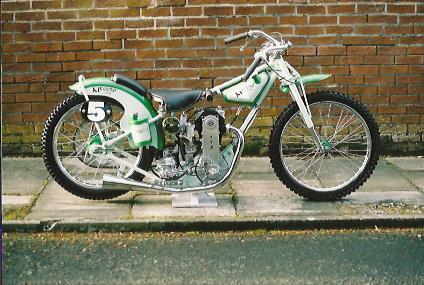
If you read my recent post on Road Bikes with a Speedway Influenece then you will have seen the vintage Weslake that the guys at Flake Kings were attempting to ride on the road, well, I'm happy to tell you that it's nearly finished. The frame, forks and rims have been powdercoated, the aluminium has all been polished and all of the green parts were mega-flaked the "Flake Kings" way. Lots of special parts have been used such as the Teflon Speedway spoolhub and a hard-to-find 23inch slick front slick tyre. The speedway seat was covered in a matching flake vinyl by Miller Kustom Upholstery. Now all they need is some methanol and to get this bike on the road... Oh Yeah!

The excellent photographs were taken by Limpe Iven 

Leigh Adams Support Group

Australian Speedway motorcycle legend, Leigh Adams, continues to do “better than expected” in the aftermath of the serious injuries he sustained whilst contesting the Finke off road event in Alice Springs, |Australia earlier this month. Adams, aged 40, from Mildura in Victoria, is making good progress following major surgery to strengthen his damaged spinal cord and this week he took a massive step on the road to recovery by leaving hospital and moving to a specialist rehabilitation centre. “Leigh is doing well and is continuing to make small improvements on a daily basis,”  said Leigh's wifes Kylie today.

Photo courtesy of Mike Patrick


"He is remaining positive and upbeat. Doctors are very impressed with his progress and they feel he will continue to move forward in rehab. He has settled into his new environment and is enjoying the benefits of increased mobility, cruising outdoors in a wheelchair for short periods whilst enjoying the winter sunshine. Leigh is back to his old self in some ways and he is eating plenty (including scoffing plenty of chocolates that have been sent to him) and he’s been ordering freshly squeezed orange juice, home grown from his own hobby farm in Mildura. This is of course the biggest challenge of Leigh’s life and he realises it is only early days, particularly with the type of injury and trauma he’s been subjected to. He knows this type of injury can’t be rushed. That being said, I’m really proud of his attitude and patience in dealing with this. I am also proud of his determination to achieve his own personal goals. The support we have received from all around the world has been absolutely overwhelming and we welcome the continuation of further messages of support". Kylie concluded.

Immediately after the popular Aussie’s accident, the Leigh Adams Love & Support Group, was set up on the popular social internet network Facebook. The founder of the Group, retired speedway photographer Mike Patrick, states "I am amazed at the response the Group has had worldwide".
Photo courtesy of Mike Patrick
In Leigh’s twenty year International career, he not only touched the hearts of thousands of speedway fans, but was also an inspiration to many up and coming young riders. Underlining the high esteem in which the stricken speedway star is held in, a staggering 5700 plus people have already joined the group and left messages of support, photos and memories of the stricken star. The group is easy to join, but a new email address has been set up so that non members can also leave messages etc., by emailing them to: lasupport@gmail.com and they will be placed on the group pages. It has been realised that a previous email given does not work, so please send your messages again. (Pease leave messages in English if possible).


Mike Patrick is urging fans to keep their messages of support flowing saying, "Leigh does get to read the messages and the Adams family are so very grateful and overwhelmed by the warmth and love that everyone has showed, which will help him with the hard battle that he faces. In addition I’ll be posting any press releases or further news from Kylie as it’s received". Anyone can read the messages by going to the Leigh Adams Love & Support facebook page.
Kylie, Declan, Leigh and Casey Adams
photo courtesy of Mike Patrick
Further details can be found at www.leighadams.com
THE SPEEDWAY WORLD IS TRULY UNITED IN BACKING LEIGH AND
HIS FAMILY AS HE BATTLES TO OVERCOME HIS INJURIES

Northside Speedway Training Track

Speedway fans, riders of the past and present and most definitely riders of the future. I bring the excellent news that the Northside Training Track in Cumbria is Under New Management!

A group of dedicated people, all connected with speedway in one way or another, have taken over the track, which is located in Workington. They have the ambition and plenty of ideas to get British talent back to the top. There is a strong team of local speedway fans ready to start work on improving the track and its facilities this week. They want to ensure that the best training is delivered and that everyone who visits Northside will want to come back. again and again. 

Training sessions are set to resume in June this year and it is hoped that mini-matches can be arranged and all are hopeful that the popular a round of the British Under-15 Championships series will return to Northside in the future too.

There will be great incentives given to regular visitors, a choice of 125cc, 250cc and 500cc bikes for hire, riding gear for hire and expert guidance from experienced riders. Everyone can be catered for at Northside Training Track... first timers, old timers, youngsters, wannabes and of course the locals.

Max Clegg in action at Northside in 2010.
Photo courtesy of John N Miller photography
Please take a look at the new Northside Training Track website for details, photos, dates, events, sponsorship opportunities and contacts. The website is new too, so don't expect too much content yet, but keep checking back for regular updates .

Spread the word, this is the re-birth of something big!

Custom Speedway Bike for the road...

With huge thanks to my internet pal Benny Ludolphy in Holland, here's a rockin customised speedway bike with loadsa chrome... I wouldn't want to pull a wheelie and land on that rear mudguard though!!!
Photo courtesy of www.BikerHotline.com
More street legal speedway bikes on my previous post here

Harry Skirrow - "The One-Armed Lakeland Wonder"

"Perhaps the least known and most underrated racing car constructor in this country". That is how author Derek Bridgett described Henry (Harry) Skirrow in his book "Midget Car Speedway". That statement is very true. Without a doubt, it was Harry's skill, drive and initiative that produced the UK's most successful midget speedway cars, but there was so much more to this great man than has ever been published before.
Born in Bradford in 1906, Harry was raised in Westmorland (now part of Cumbria). Harry began his working life as a banker, but he soon became bored with the mundane occupation and opened his own motor garage on Lake Road in Ambleside, close to the shore of Windermere in England's Lake District.

During their teenage years, the brothers had both been bitten by the motorcycle bug and competed in sand races, speed trials and grass track events and they were both founder members of the reformed Westmorland Motor Club. Harry and Geoffrey were pioneer speedway riders too. Harry had finished 2nd to his brother in the 350cc event at the first Whitehaven meeting in July 1930 and they were both winners of the Silver Goblet and Silver Rose Bowl at Barrow-In-Furness speedway during the same year. At one stage Harry was a promising novice at the Preston speedway track, but then he lost his left arm in a shooting accident and everyone presumed his motorcycle racing days were over - everyone except Harry that is! With the aid of an artificial forearm and a hook, Harry started riding again and even amused himself by riding speedway again, albeit behind closed doors at the famous Belle Vue track in Manchester. He was such a fan of the sport that he would drive down to Manchester to watch the "Aces" most weeks and it was here that he first saw Midget Car Speedway. On May 16th 1935, Belle Vue Speedway presented an "All Car Meeting", which was reported as a failure, but it obviously caught the imagination of some and fired a new enthusiasm in Harry Skirrow.

Harry returned to Ambleside and built his own midget racer based on the wreck of an old BSA Scout. He returned to Belle Vue as a competitor and despite having the fastest car around the Manchester track, he was still not satisfied. With the help of Walter Mackereth, a blacksmith from Kendal, they built a new car and took it to Flookburgh Sands for testing. They experimented with front wheel drive, rear wheel drive and different wheelbases until they eventually produced a car that they were both satisfied with and turned their attentions to domination of the UK midget speedway car scene.
Harry Skirrow's first attempt at a commercial Midget Speedway racing car.
The fully developed "Skirrow Special" from 1936
(Photo courtesy of Malcolm Skirrow)
I have a copy of a letter drafted by Harry on various scraps of paper and intended to be sent to Michael Ware at the National Motor Museum in Beaulieu that tells the story of how the famous Skirrow Special developed...

In the letter Harry describes how, with more enthusiasm than judgement, he sold his garage at Ambleside and put all his resources into producing a car that fulfilled the rules of midget car racing in the USA. He then relocated to London and rented a workshop from Victor Martin in Tottenham. Harry had asked the neighbouring firm of J.A.Prestwich to produce a 1000cc air-cooled v-twin engine based on two 500cc speedway J.A.P. units. The two cylinders were mated to a common crankcase and each cylinder had its own twin monobloc Amal carburettor and ran on methanol. This engine became known as the 996cc J.A.P. 8/80. The chassis and pressed steel disc wheels were produced by Rubery Owen and Harry also persuaded John Bull to produce special tyres using the same tread pattern and compounds as the larger 20" speedway bike tyres.
996cc J.A.P. 8/80 engine.
A cutaway showing the 4-wheel drive chassis of the Skirrow.
By the Spring of 1936 Harry had produced his first few complete cars and presented them to Eric Spence at Belle Vue Speedway. At first he wasn't interested as he wanted to produce his own cars based on the American Elto design, so Harry became a partner in Liverpool Speedway which allowed him to race and demonstrate his cars to his hearts content. It wasn't long before the Skirrow was recognised as the best car for the job and Harry eventually joined forces with Jim Baxter and the Belle Vue management to form a national midget car racing league with Harry and his wife promoting their own tracks at Lea Bridge in London and at Coventry in the Midlands.
Action from Coventry in 1937.
Ginger Pashley in an Elto leads Walter Mackereth in a Skirrow.
Not only was Harry a talented designer, fabricator and a budding businessman, he was also an exceptional driver. In his book "Coventry's Two Speedways", author Colin Parker describes how Harry managed to turn his car onto its side during a meeting at Wembley. He scrambled out, pushed it back onto four wheels with his single arm and carried on racing. The same book also describes how the cars had to be transported from their Tottenham workshops to the Brandon track at Coventry, either on the back of a truck or being towed behind it, with the "driver" exposed to the elements in all kinds of British weather.
Harry sitting at the wheel of the final development of the Skirrow Special.
(Photo courtesy of Malcolm Skirrow)
In his letter Harry continues to describe the diffficulties he faced. Despite being totally under capitalised and running into severe financial difficulties during the recession of the 1930s, Harry did not give up on his dream and persevered with developing his Skirrow Special and promoting racing or "Doodle Dicing" as it had become known, at more venues. He had plans to introduce his "Doodle Bugs" to the Moorville Speedway in Carlisle in partnership with Roland Stobbart and Jimmy Baxter, but the venue never recovered from the financial disaster of its one and only motorcycle speedway meeting and the proposed project never materialised. 
Coventry driver Frank Chiswell in his Skirrow No 77.
(Photo courtesy of Roy Chiswell)
Walter Mackereth and his Coventry team were crowned League Champions in 1938 and Harry was just beginning to reap the rewards of his dogged determination. Crowds were increasing and Harry had been invited to tour Australia over the winter of 1939/1940, but the events that followed were completely out of Harry's hands. Poor summer weather in 1939 had caused a lot of meetings to be rained off and combined with gathering war clouds, the midget car league was abandoned in July 1939. Consequently, the trip to Australia was also cancelled. Fate dealt another blow in 1940 when Harry's house was completely demolished during an air raid, destroying all of Harry's records, drawings, photographs and press cuttings. At this point Harry sold his business to Victor Martin, paid off his debts and relocated back to the North West to join his son Malcolm, who had already been evacuated from London and was living with an Aunt in Bowness-On-Windermere. The family eventually settled into a house just south of Lancaster and Harry turned his attentions to producing aircraft parts for the war effort. He joined forces with William "pops" Kitchen, a former partner of his at Liverpool speedway and the father of Belle Vue speedway star Bill Kitchen, in a small factory unit in the village of Galgate.

After the war had ended there was no immediate resumption of midget car racing and Harry found that he had lost touch with his associates and his cars. More importantly, Harry wasn't willing to take any more financial risks having lost everything in the 1940 air-raids. Bill Kitchen and his brother Jack were due to be demobbed from the Army and would be returning to the family business, so Harry decided it was time to move on again, this time to Devon.

The family bought a house in Maidencombe, just outside of Torquay and Harry persuaded his brother Geoffrey to join them. The two brothers bought a market garden and then sold it for a hefty profit in 1947. Their next venture was to buy the Loughton Motor Company in London together with some war surplus Nissan huts, which were erected next to the garage and rented out as storage.

Harry had managed to recover three badly damaged Skirrow cars from the remains of his garage at the bombed out house in London and had taken them to Devon where he rebuilt two and sold them. The third chassis became a donor for a single-seat sports car that Harry built in order to travel to London and back whilst overseeing his business. The car was described as looking like a miniature Allard. It used the same 996cc 8/80 J.A.P. engine as the midget racers with the addition of a 4-speed motorcycle gearbox, which Harry modified to give the car a reverse gear. Unlike the racing cars, this road legal Skirrow was front wheel drive, ran on petrol and could return 70mpg at a steady 60mph.
Harry with his home-made sports car, which he drove to London and back on a regular basis.
Eventually a compulsory purchase order was put on the garage to allow for the construction of a new road and harry and Geoffrey were out of a job. Geoffrey found some part-time work helping out at the local service station at Chudleigh and Harry spent most of his time indulging in his new hobby - sailing, but they both became bored without regular work and bought the Maidencombe Service Station in 1952.

Harry sailed a 14 feet redwing yacht with the Babbacombe Corinthian Sailing Club, where he built and installed a motorised winch to haul the boats up the beach and also built trailers for other club members. Harry still had a strong competitive streak too and was awarded the prestigious Sir Reginald Leeds Trophy in 1959 after nine consecutive race wins in the Torbay Regatta and two race wins at Falmouth.
Harry out sailing in 1953.
(Photo coutesy of Malcolm Skirrow)
When Geoffrey died, Harry sold the garage and gave half the proceeds to his widow. He then went to work for his son Malcolm at his garage in Babbacombe, travelling to work and back every day on a 90cc Honda Cub. Even though Harry always said he never wanted to retire, his Doctor had other ideas and in 1984 Harry finally went home for a rest aged 77 and eventually passed away in 1991 at the age of 84.

He was once asked in a newspaper if having only one arm had made life difficult... "Oh no" he said, "If I had another arm I just wouldn't know what to do with it, I can do most jobs and if I'm beaten I just ask for help. With this hook I can hold a welding rod right down to the last bit without burning my fingers, but there are some things that are on the official list of things I can't manage, like the washing up".

Shortly before he died Harry said to his wife... "I think I've done just about everything in life that I wanted to", to which his wife replied... "Yes - You bloody well have!".

But what became of the Skirrow cars? Victor Martin continued to provide service and spares after the war under the name of "Skirrow Special Cars Ltd" and his friend and colleague Walter Mackereth continued to race with great success in Hamburg and Paris. Most of the remaining cars were purchased by David Hughes, a midget car racing enthusiast from the East Midlands, who had built his own racing track in 1949 at Brafield in Northamptonshire. Hughes then took the Skirrows on tour in 1950 followed by the formation of  the Midlands Midget Speedway Car League in late 1951. Sadly, the league featuring teams from Birmingham, Cradley Heath, Coventry and Leicester was short lived and was abandoned before the year was out. By the end of the 1950s the cars were beginning to wear out and Victor Martin was no longer able to provide back-up. Some of the cars were cannibalised to keep others going but Hughes eventually had to admit defeat. Thankfully a few Skirrows have survived and are now in the hands of enthusiasts and collectors who acknowledge the historical importance of the Skirrow Special.
A preserved 1938 Skirrow Midget Speedway Car. Originally from Canada, this car was recently sold at auction and is now in Australia. Although not completely original, it does represent Harry's later development of the Skirrow vey well. This particular car has been discussed at length on Midget Car Panorama (see link at foot of page).
Massive thanks to Harry's son Malcolm Skirrow for letting me have copies of Harry's letters, photographs and giving me a potted history of Harr'y life. Thanks also go to Derek Bridgett, Colin Parker and Roy Chiswell, and also to Percy Duff and the late Bernard Crabtree for sharing their memories of Harry.


References:
Midget Car Panorama - A Forum for Midget Car Racing.
Midget Car Speedway by Derek Bridgett
Coventry's Two Speedways by Colin Parker
and various Stock Car Racing articles by John Hyam.

Barrow Speedway - A (very) brief illustrated history

The origins of speedway and dirt-track racing on the Furness peninsular can be traced back to he beach races organised by Barrow & District Motor Club in the 1920s. The club later held a grass track meeting at the Little Park Rugby Ground in Roose on May 26th 1928. The winner of the unlimited races at this meeting was local hero and future Belle Vue and Wembley star Frank Charles , who literally lived over the road from the stadium on North Row, Roose. In 1930, the Northern Motor Sports Club introduced Speedway racing to the Holker Street football stadium. A track made of rolled ashes from Vickers Shipyard was laid around the football pitch and a total of seven meetings were held before the Football club needed to re-turf their pitch in readiness for the new season. The winner of the opening meeting on 12th June 1930 was Eric Airey from Lancaster and over 7000 spectators watched the final meeting on July 28th.
Frank Charles and Eric Airey get ready for a match race at Holker Street in 1930
Not sure of the rider in the white jersey, but the other 2 riders are Roland Stobbart and Frank Burgess.
 A rare action shot from Holker Street in June 1930
During the 1950s, Cliff Hindle, a local motorcycle enthusiast, built his own private circuit where he and several other enthusiasts could practice prior to riding at Belle Vue and Sheffield, but it wasn't until 1972 that speedway racing returned to Barrow-In-Furness. A new track was constructed around the pitch at Holker Street and Barrow enjoyed three unsettled seasons of league racing at the football stadium, firstly with the Barrow "Happy Faces" who finished 9th in the 1972 second division, and then the Barrow "Bombers" who finished around mid-table in the 1973 and 74 seasons. The football and speedway clubs were uneasy partners though and talks broke down right on the eve of the 1975 season and Holker Street closed its doors to speedway again.
Mike Watkin - 1972
Bob Coles - 1972
Local rider Ian Hindle - 1972
Tom Owen - 1973
Terry Kelly - 1973/74
(Photos above all by R.Spencer-Oliver)
Sid Sheldrick in action at Holker Street 1974.
(Photo by Roy Dixon)
Chris Pusey of Belle Vue leads Chris Roynon at Holker Street in 1974
(Photo by Roy Dixon)
Cliff Hindle enters the scene again in 1977 by building a brand new track and stadium at Park Lane on the outskirts of Barrow. After a season of challenge matches, the "Furness Flyers" entered the 1978 National League, but a weak team finished bottom of the league with only 18 points to their credit and the track did not reopen in 1979. Speedway did make a brief return to Park Lane in 1981 when the temporarily homeless Berwick "Bandits" used the track for 5 league matches and 1 KO Cup match.
Chris Roynon and Andy Reid - 1978
(Photo by R.Spencer-Oliver)
Geoff Pusey - 1978
Chris Robins - 1978
 In 1983, Chris Roynon purchased the derelict stadium from Cliff Hindle and rebuilt it. Throughout the year he ran monthly stock car meetings and occasional speedway training sessions. A series of seven "open" meetings were then staged in 1984, four of the matches featured the Barrow "Blackhawks" racing in challenge matches and another featured the Barrow "Braves", a team comprised of junior riders. The "Blackhawks also competed in one away fixture at Edinburgh. The Barrow "Blackhawks" entered the 1985 National League, but this was possibly the weakest team ever seen in National League speedway and they were expelled from the league in May. Roynon continued to promote challenge matches and individual trophy meetings at an intermediate level, culminating in the Cumbrian Open Championship on Sept 24th 1985. The last ever speedway meeting to be held at the venue. Stock meetings continued until 1987 when the track was covered over with a greyhound track. Prior to demolition in 1994, local motorcycle dealer Martin Crooks and teenage prospect Grant McDonald used the old track for practice session, but the bikes have remained quiet ever since.
Rob Grant of Berwick leads Kevin Armitage and Gary O'Hare - Park Road 6th May 1985
Jim Mcmillan and Rob Grant lead Gary O'Hare and Paul Price - Park Road 1985
A Fabulous view out into Morecambe Bay too
Eric Broadbelt, Rob Grant, Bernie Collier, Bruce Cribb - Park Road 1985
(Park Road photos by Philip Haynes)

Road Bikes with a Speedway Influence

For some unknown reason, speedway motorbikes have always evolved outside of mainstream motorcycle culture, and likewise, speedway still doesn't appeal to many mainstream motorcyclists, but I'm different, I don't wear dayglo leathers or Wulfsport pyjamas, I ride bikes that aren't fashionable and I love speedway!. In my last post I showed you the Yamaha XT that former Danish speedway rider Ernst Bogh had built using an old 1990s upright GM speedway engine. That post has led me to hunt out some more speedway influenced road bikes.... either based on the speedway style or using speedway components.

The functional and simplistic look of a speedway machine does have an influence on the custom scene, just compare some of the best looking Bobbers with the early dirt track bikes of the 1920s and 1930s and you will see a startling visual similarity. It's a look that I love though and from my recent Internet trawls, it looks like I'm not alone. I came across this bike on Chris Barber's Crossbreed Cycles website, unfortunately I haven't been able to contact him so I can only give you the information from the website.
This bike was built using an assortment of parts including a 1940s Matchless G3 frame, a Brooks bicycle seat, an upright GM speedway engine, Burman gearbox, Suzuki RM125 front wheel with a magnesium hub, and the rear wheel is actually a Husquarvana front rim with an alloy Bultaco hub. All efforts went into making this machine as light as possible, hence the choice of components, even the rear mudguard stays are hollow tube. This machine is road legal in the UK but for daylight use only. Chris says that 55bhp + 205 lbs dry weight = FUN!

Here's another road legal bike, a Triumph that looks just like a real dirt-tracker. We really don't see this look often enough on the UK scene, but I'm a firm believer in the simplistic "form and function" style - it's killer... and with the amount of potholes littering UK roads, the hard-tail back end really would be a killer!
Over at the Flakekings' blog they are currently trying to get a couple of vintage speedway racers ready for the street. Oh yes, you did read that correctly... road legal speedway bikes!!! As they say, the design and bare bones look of these bikes just can't be beat! I totally agree so keep stopping by the Flakekings blog to see how they're coming on.
FlakeKings Weslake project
FlakeKings Jawa project.

Finally on this post a Speedway Jawa Streetfighter from Finland which I found on the JL Meccanica blog.

Ernst Bogh had a short spell riding speedway for Leicester and Sheffield in 1976, but he never really made the grade and returned home to Denmark where he continued to ride for many years. Today he has a small collection of vintage speedway bikes and tells me that he is always interested in seeing what other people have in their garages Ernst would love to add a Street Mk2, a 4-valve J.A.P. and a Briggo 4-valve conversion to his own garage, so if you should hear of any for sale, please leave a comment for me to pass on to him. 

Here's a couple of my favourite machines from Ernst's collection. The first is a Yamaha XT600 chassis fitted with an upright GM speedway engine, Norton gearbox, an NEB belt drive and 17" SuperMotard wheels. Ernst describes it as a "..fun bike to ride on sunny afternoons".  The second machine is a fantastic J.A.P speedway machine that Ernst built from scrap parts. It now lives in his office along with some of Ernst's speedway trophies.
Yamaha XT with GM speedway engine, Norton gearbox and NEB belt drive
Speedway JAP built from scrap parts and now living in Ernst Bogh's office in Denmark.

"FROM CINDER TO SHALE" - Open Days 2011.

I've been talking to my friend Ian Paterson this week. He has collected and restored what is probably the finest collection of dirt-track and speedway bikes in the country and as a treat for all the dirt track junkies out there, Ian is very kindly throwing open the doors of his magnificent collection for some open days this year. The collection is based just outside of Edinburgh. If you are interested in taking a look, give Ian a call on (+44)131 440 0864, leave your contact details and Ian will call you back. This is a once in a blue moon opportunity and I promise that you will not be disappointed.

Here's a few photos to give you a flavour of what's in store... (Photos are all copyright of Ian Paterson).
1929 OEC - duplex steering, long wheel base and suicide shift - Now that would really be something to get sideways!
1930 James V-Twin - lovin' that fancy exhaust.
1930 Norton.
This famous British Marque produced a dirt track bike based on their famous road racing machines.
You can see more about the bike here.
1934 Crocker - painted in the colours of Manuel Trujillo.
You can read more about the history of the Crocker in my previous post here
1934 Harley-Davidson CAC.
The Harley-D Cinder Racer is a rare beast but there are more on my previous post here.
The Vampire! 1947 Vincent with copper plated frame.
1957 Meguro - Japanese Autorace bike with asymetrical handlebars.

top