Your Favorite Five #007

.

Justin Kell was born in 1970 in Harrisburg, PA. In 1997 he relocated to Los Angeles from Baltimore Maryland. Upon arriving in Los Angeles he turned his love of vintage motorcycles and American antiques into his life’s work.
In 1999 GLORY Sales & Service was opened with his wife Kristina Kell.
We met Justin a couple of years ago in his store, this guy is rad and cool and his store is a "Must see" in L.A.


Naming my five favorite motorcycles sounded easy at first. Making a living working with bikes, I have an odd “love/hate” relationship with motorcycles. Vintage motorcycles are never “finished”. Like the painting of the Golden Gate Bridge, they are in a constant state of repair. This being said, it’s the reason that we love and hate these relics. As I fished through he dark recesses of my brain, I realized that the machines that kept popping into my mind were the machines that made me smile. They are bikes that I have an emotional attachment to. I buy and sell a lot of vintage machines, and I still after quite a few years find myself wanting to keep every bike that I touch. The choices here may seem odd, but like women, these machines have a certain look, smell and taste that won’t let me forget them.

In no particular order….

1. 1953 Vincent Comet

I love the Vincent singles for many reasons. In my opinion, this is one of the most ride able machines that ever came out of the Stevenage factory. The Comets were really a single cylinder touring bike. They have a reputation for being a “vibration less” single and I have to agree. The simplicity and pure function of a 500cc single is unbeatable. Being built over the same bottom end set up as a twin, they are very close to bullet proof. These machines can be easily tuned to run a solid 90mph on a modern freeway while still being light and nimble enough to shoot through LA traffic. My only complaint is the lazy Burman gearbox, but this can easily be fixed by the fitting of a Dominator box from our good friends at Norton. Old guys with beards like to call them “1/2 a Vincent”. Old guys with beards park $100K Shadows in their living rooms. I’ll take a well-sorted Vincent single over a twin any day.

2. 1965 BSA A-65

That’s right, an A65. These machines have taken a beating over the years. With tall tales of exploding bottom ends and non oiling, they became known as Triumph’s half with cousin. I love the old “Power Egg”. I’ve had quite a few of these machines over the years, and I always enjoy them. It is true that the parts availability in the US isn’t as easy as the Triumphs, but a well-built A65 is a great machine for Los Angeles. Thunderbolt is actually my A65 of choice. The single carb 650 is simple and delivers about the same punch as the twin carb lightning’s but with one carb to deal with instead of two. Add a Boyer, a Pod-Tronic and a 34mm Mikuni, and you’re in fine shape. The gearing, like most 60’s British twins, is in need of a bit more, but these machines were not conceived for 80 mph on a freeway. The application should fit the design. Visually, I love the tank badges of the 65’s and the paint on chrome fuel tanks. These bikes have always looked like the quintessential British bikes to me. I’ve built them into café racers, CA street trackers and kept them stock. A great machine, still affordable, and an absolute a joy to ride. Long Live Birmingham!

3. 1962 Norton Atlas

1962 was the first production year of the 750cc Atlas.I love this year because They still retained UK styling over the attempt to “Americanize” the design to appeal to us Yanks. The classic silver paint, the speedometer in the headlamp bucket, all classic lines that make this machine feel like the hopped up Dominator that it was. Enough cannot be said bout the superior handling of the Featherbed frame. I personally prefer the slim line frames over the wide lines. The Altlas has a well deserved reputation for being a bit on the vibraty side, but I’ve ridden some that feel like jack hammers, and some that are a smooth as silk. Balancing the crank and sorting out the rods does wonders for the vibration. The handling of these bikes is as good as it gets. The single leading brakes can be set up to do the job, but an easy conversion to a Commando brake is a smart move. The obvious “Manx” conversion is time tested and always a winner, but there’s something to be said about an early Atlas in original condition. I’ve put about 60 K miles on my latest Atlas (a ’65) and it just keeps going. The Norton gearboxes are strong, the Road Holders are always a treat and the simple conversion of a single Mikuni gives you a good smooth power delivery. The later models had a distributor, but the early ones sported a mag. You can’t beat a magneto. My current set up is a Lucas Rita mag replacement that was on the bike when I got it, and it’s been providing flawless ignition for 5 years. No need to toss a Triumph motor in this bike. The Atlas motor is stronger and much more reliable. A Featherbed frame and a 750 Norton lump. What could possibly go wrong?

4. 1969 Moto Guzzi V7

When I was about 19 years old, I bought a ’69 V7 for $500. What a bike. I was not terribly interested in Italian bikes, but I kept seeing this bike in my neighborhood and developed a fixation with it. The bike belonged to a friend of mine who had two expensive habit, vintage guitars and heroin. I constantly harassed him to sell me the Guzzi. One day when habit number two was in need of some servicing, he sold me the bike. Unfortunately, habit number two killed him a few weeks later. I still remember riding that thing through my crappy Baltimore neighborhood. I wasn’t wearing a helmet, and I felt like the coolest guy in the world. That is the power of a crappy old bike that still keeps me going 20 years later. The machine itself toed that thin line between ugly and beautiful. Kind of like French women. Like the French women, a marginally attractive machine can become the sexiest thing you’ve ever seen because of timing and circumstance. It was red with chrome panels on the fuel tank. It was quite heavy, but smooth. Man I loved that bike. The great thing about these bikes is the smoothness and reliability. Guzzi’s are strange machines I’ve always considered them German versions of Italian machines. Pure function over form, but in the right light, really quite exciting. I still miss this bike and know that one day I will find it and buy it back.
5. 1937 Indian Sport Scout

If you’ve never ridden a pre-war Indian, you’re really missing something spectacular. These are the best representation of classic American motorcycles out there. I’ve spent quite a bit of time aboard a ’38 Chief, but the ’37 Sport Scout wins my heart. These bikes are much quicker than you expect them to be. Sure, the Chief is the most known and carries the American bigger is better credibility, but the Sport Scout’s are quick and a real joy to ride. The first time that I ever rode a Sport Scout was through LA traffic. It was terrifying and thrilling and nerve racking and fun. The beauty of the heel toe clutch and the left-hand throttle make much more sense than you would think. I won’t lie, it does take a bit to get used to, but it really makes you feel like you’re operating the machine. This isn’t a press a button and rides smoothly kind of bike. This is all appendages doing different things. This is hot and oily and not quite exact science. This is a really fast tractor with the threat of suspension. The Sport Scouts were the choice machines for racing and hot rodding here in Southern California. When I see a Sport Scout, it is exactly what comes into my mind when I think of a Classic American motorcycle. Indians have a great mystic and appeal. A chief with the skirted fenders surely is a beauty, but the Sport Scouts were the café racers, the Sport Scouts were the hot rods. These were the bases for the first bobbers, and still dictate the lines of backyard customs built today. These truly are my favorite American Machines, and really do mean Southern California to me. God Bless America!

Ha Ha ! you like it?
Rendez vous next week!

.
.

Justin Kell was born in 1970 in Harrisburg, PA. In 1997 he relocated to Los Angeles from Baltimore Maryland. Upon arriving in Los Angeles he turned his love of vintage motorcycles and American antiques into his life’s work.
In 1999 GLORY Sales & Service was opened with his wife Kristina Kell.
We met Justin a couple of years ago in his store, this guy is rad and cool and his store is a "Must see" in L.A.


Naming my five favorite motorcycles sounded easy at first. Making a living working with bikes, I have an odd “love/hate” relationship with motorcycles. Vintage motorcycles are never “finished”. Like the painting of the Golden Gate Bridge, they are in a constant state of repair. This being said, it’s the reason that we love and hate these relics. As I fished through he dark recesses of my brain, I realized that the machines that kept popping into my mind were the machines that made me smile. They are bikes that I have an emotional attachment to. I buy and sell a lot of vintage machines, and I still after quite a few years find myself wanting to keep every bike that I touch. The choices here may seem odd, but like women, these machines have a certain look, smell and taste that won’t let me forget them.

In no particular order….

1. 1953 Vincent Comet

I love the Vincent singles for many reasons. In my opinion, this is one of the most ride able machines that ever came out of the Stevenage factory. The Comets were really a single cylinder touring bike. They have a reputation for being a “vibration less” single and I have to agree. The simplicity and pure function of a 500cc single is unbeatable. Being built over the same bottom end set up as a twin, they are very close to bullet proof. These machines can be easily tuned to run a solid 90mph on a modern freeway while still being light and nimble enough to shoot through LA traffic. My only complaint is the lazy Burman gearbox, but this can easily be fixed by the fitting of a Dominator box from our good friends at Norton. Old guys with beards like to call them “1/2 a Vincent”. Old guys with beards park $100K Shadows in their living rooms. I’ll take a well-sorted Vincent single over a twin any day.

2. 1965 BSA A-65

That’s right, an A65. These machines have taken a beating over the years. With tall tales of exploding bottom ends and non oiling, they became known as Triumph’s half with cousin. I love the old “Power Egg”. I’ve had quite a few of these machines over the years, and I always enjoy them. It is true that the parts availability in the US isn’t as easy as the Triumphs, but a well-built A65 is a great machine for Los Angeles. Thunderbolt is actually my A65 of choice. The single carb 650 is simple and delivers about the same punch as the twin carb lightning’s but with one carb to deal with instead of two. Add a Boyer, a Pod-Tronic and a 34mm Mikuni, and you’re in fine shape. The gearing, like most 60’s British twins, is in need of a bit more, but these machines were not conceived for 80 mph on a freeway. The application should fit the design. Visually, I love the tank badges of the 65’s and the paint on chrome fuel tanks. These bikes have always looked like the quintessential British bikes to me. I’ve built them into café racers, CA street trackers and kept them stock. A great machine, still affordable, and an absolute a joy to ride. Long Live Birmingham!

3. 1962 Norton Atlas

1962 was the first production year of the 750cc Atlas.I love this year because They still retained UK styling over the attempt to “Americanize” the design to appeal to us Yanks. The classic silver paint, the speedometer in the headlamp bucket, all classic lines that make this machine feel like the hopped up Dominator that it was. Enough cannot be said bout the superior handling of the Featherbed frame. I personally prefer the slim line frames over the wide lines. The Altlas has a well deserved reputation for being a bit on the vibraty side, but I’ve ridden some that feel like jack hammers, and some that are a smooth as silk. Balancing the crank and sorting out the rods does wonders for the vibration. The handling of these bikes is as good as it gets. The single leading brakes can be set up to do the job, but an easy conversion to a Commando brake is a smart move. The obvious “Manx” conversion is time tested and always a winner, but there’s something to be said about an early Atlas in original condition. I’ve put about 60 K miles on my latest Atlas (a ’65) and it just keeps going. The Norton gearboxes are strong, the Road Holders are always a treat and the simple conversion of a single Mikuni gives you a good smooth power delivery. The later models had a distributor, but the early ones sported a mag. You can’t beat a magneto. My current set up is a Lucas Rita mag replacement that was on the bike when I got it, and it’s been providing flawless ignition for 5 years. No need to toss a Triumph motor in this bike. The Atlas motor is stronger and much more reliable. A Featherbed frame and a 750 Norton lump. What could possibly go wrong?

4. 1969 Moto Guzzi V7

When I was about 19 years old, I bought a ’69 V7 for $500. What a bike. I was not terribly interested in Italian bikes, but I kept seeing this bike in my neighborhood and developed a fixation with it. The bike belonged to a friend of mine who had two expensive habit, vintage guitars and heroin. I constantly harassed him to sell me the Guzzi. One day when habit number two was in need of some servicing, he sold me the bike. Unfortunately, habit number two killed him a few weeks later. I still remember riding that thing through my crappy Baltimore neighborhood. I wasn’t wearing a helmet, and I felt like the coolest guy in the world. That is the power of a crappy old bike that still keeps me going 20 years later. The machine itself toed that thin line between ugly and beautiful. Kind of like French women. Like the French women, a marginally attractive machine can become the sexiest thing you’ve ever seen because of timing and circumstance. It was red with chrome panels on the fuel tank. It was quite heavy, but smooth. Man I loved that bike. The great thing about these bikes is the smoothness and reliability. Guzzi’s are strange machines I’ve always considered them German versions of Italian machines. Pure function over form, but in the right light, really quite exciting. I still miss this bike and know that one day I will find it and buy it back.
5. 1937 Indian Sport Scout

If you’ve never ridden a pre-war Indian, you’re really missing something spectacular. These are the best representation of classic American motorcycles out there. I’ve spent quite a bit of time aboard a ’38 Chief, but the ’37 Sport Scout wins my heart. These bikes are much quicker than you expect them to be. Sure, the Chief is the most known and carries the American bigger is better credibility, but the Sport Scout’s are quick and a real joy to ride. The first time that I ever rode a Sport Scout was through LA traffic. It was terrifying and thrilling and nerve racking and fun. The beauty of the heel toe clutch and the left-hand throttle make much more sense than you would think. I won’t lie, it does take a bit to get used to, but it really makes you feel like you’re operating the machine. This isn’t a press a button and rides smoothly kind of bike. This is all appendages doing different things. This is hot and oily and not quite exact science. This is a really fast tractor with the threat of suspension. The Sport Scouts were the choice machines for racing and hot rodding here in Southern California. When I see a Sport Scout, it is exactly what comes into my mind when I think of a Classic American motorcycle. Indians have a great mystic and appeal. A chief with the skirted fenders surely is a beauty, but the Sport Scouts were the café racers, the Sport Scouts were the hot rods. These were the bases for the first bobbers, and still dictate the lines of backyard customs built today. These truly are my favorite American Machines, and really do mean Southern California to me. God Bless America!

Ha Ha ! you like it?
Rendez vous next week!

.

Bruce Cribb, "The Worlds Fastest Maori" This story adapted from an article in the NZ Herald on Feb 3rd. 2006 and published on the Taranaki Historic Speedway web-site
Bruce Brian Hoani Cribb was born on June 27th 1946 in Palmerston, New Zealand and made his debut in British speedway at the launch of the British league in 1965. He featured in 11 matches for the Poole "Pirates" in that season recording an average of 3.04. He showed slow but steady progress and it was five years later he scored his first full maximum, the same Year that Poole won the British League title. He moved to Exeter in 1970 and spent three years at the County Ground emerging as a top scorer despite being plagued with injuries. Bruce made 16 appearances for Exeter in 1970 from which he had a very healthy average of 9.47, and in 71 he was ever present and increased his average to 8.92 from his 37 matches. His average dropped in 1972 when he got 5.75 from 15 matches for the Falcons. Bruce left Exeter at the close of the 1972 season and joined up with Cradley Heath where he became a cult hero with the Black Country speedway fans. His battling performances in the top flight are still remembered today. He later had spells with Bristol, Wolverhampton, Birmingham and Berwick before returning to the County Ground in 1986. Head injuries from a horrific accident cut short his 1987 season to just one match, and although he bounced back to qaulify for the 1988 World Individual Ice Final, he rode only a handful of matches for Exeter averaging 3.24 from only 8 appearances. That was to be his final season before announcing his retirement, and Exeter staged a benefit meeting for him in 1989. Bruce's finest moment must have been when he teamed up with the legendary Ivan Mauger to secure New Zealand's only world team title in the 1979 finals at London's White City.
Lately, Bruce has dubbed himself  'The World's Fastest Maori' With his 500cc Jawa ice racing machine, having broken the track record in 16 out of 17 attempts at British speedway tracks and also done the same at the Rosebank track in Auckland, New Zealand. Bruce says: "I was in the world top 20 for ice riding at one time, but a lot of those guys were way ahead of me in skill. Yet they have tried this in Sweden and smashed up big time. I don't know why."  Bruce, whose late father Kiwi was a national speedway champion, was raised in Palmerston North before heading to the UK as a teenager to pursue his career. In the mid 1970's he answered an advertisement placed by the British speedway control board looking for riders willing to have a go at ice racing, whose strongholds include Sweden, Holland and the old Soviet Union territories. This took Bruce deep into the old USSR to Ufa (now the capital of the Republic of Bashkortostan), about 1000km east of Moscow. It was a world away from the sort of riding Bruce was used to in Europe. Temperatures dipped to 40C below zero, the heated pits were located under the grandstand, ice walls and straw bales surrounded the track.
Bruce, who still lives near to the site of the old Cradley Heath track in England, managed to win a New Zealand title but rarely returned there otherwise. He was persuaded out of retirement to demonstrate the ice bike at the 75th anniversary of the Palmerston North, (NZ) in 2006. The obvious difference between the ice bike and a normal bike are the 5cm spikes protruding through the tyres - 240 of them on the drive wheel and 120 on the front. The powerful grip allows Bruce to reach amazing speeds on tyres pumped up to 55 psi. Bruce says: "There are no spikes on the side of the wheel. The spikes actually flex over into the track - you can go around a corner absolutely flat. Your hands touch the ground sometimes."
For more insight into the career of Bruce Cribb take a look at this piece on the SpeedwayPlus website


progress report


Just recently found this cool photo showing a 1926-27 baby Harley and its proud owner. Pic is taken in Oslo late twenties.

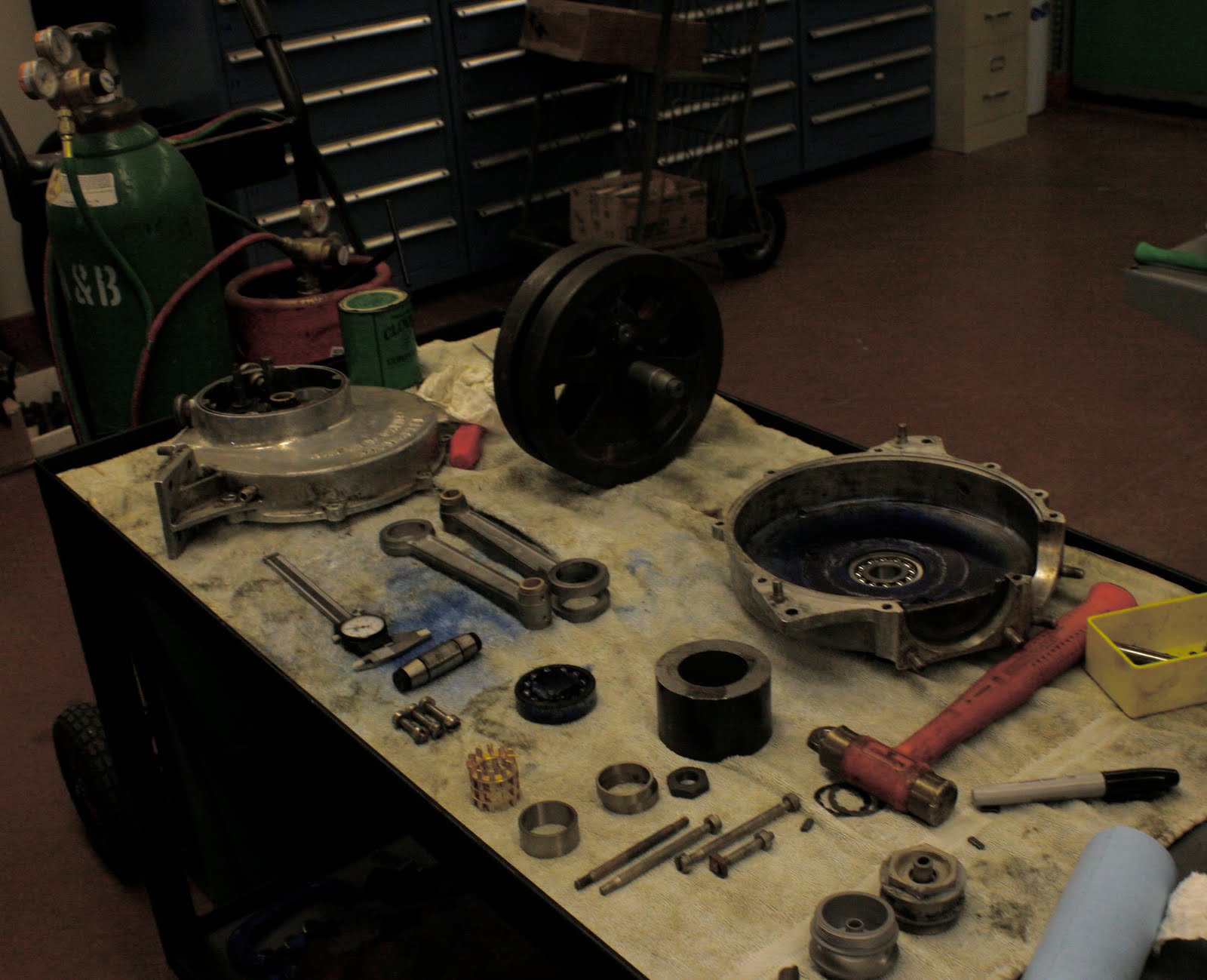
With the motor completely disassembled, we discovered the previous rebuild had left us with a scary repair on the cam, a 1/4" play in the drive shaft. A lack of replacement parts, even among the 1,000's available to us in the Competition Distributing stock, put a halt to our plan to rebuild her in a day.
I went home with my tail between my legs getting more & more nervous about the cross continental commitment I've made!


Lonnie Jr., Lonnie Sr., my uncle Curtis & other friends all teamed together in a mad rush to freshen up this beauty.

top